How to Use TNREGINET EC for Property Loan Applications 2026
If you’re looking to apply for a property loan in Tamil Nadu, one document that will almost always be required by banks is the Encumbrance Certificate (EC). This certificate proves the property has no legal disputes or outstanding loans, making it crucial for securing a loan. Thankfully, the TNREGINET portal simplifies the process of obtaining an EC, ensuring you can easily gather all the necessary paperwork from home.
In this guide, we’ll walk you through everything you need to know about the EC, including why it’s important, how to obtain it, and how it plays a role in your property loan application. Let’s dive in!
What Is an Encumbrance Certificate (EC)?
Simply put, an Encumbrance Certificate (EC) is a legal document that shows all major transactions recorded against a property — like sales, mortgages, liens, or any financial claims — for a specified time period.
Think of it this way: before a bank gives you a property loan, they want to make sure the property doesn’t have any hidden mortgages or unpaid loans on it. The EC proves that.
So the EC tells:
You can also read:How to Correct Mistakes in Guideline Value on TNREGINET 2026
Why Do Banks Ask for EC for Property Loans?
When you apply for a loan using a property as security, the bank needs to:
If the EC shows a mortgage still active, the bank might:
That’s why having a good EC makes your loan process easier.
How to Get Your EC From TNREGINET (Step-by-Step)
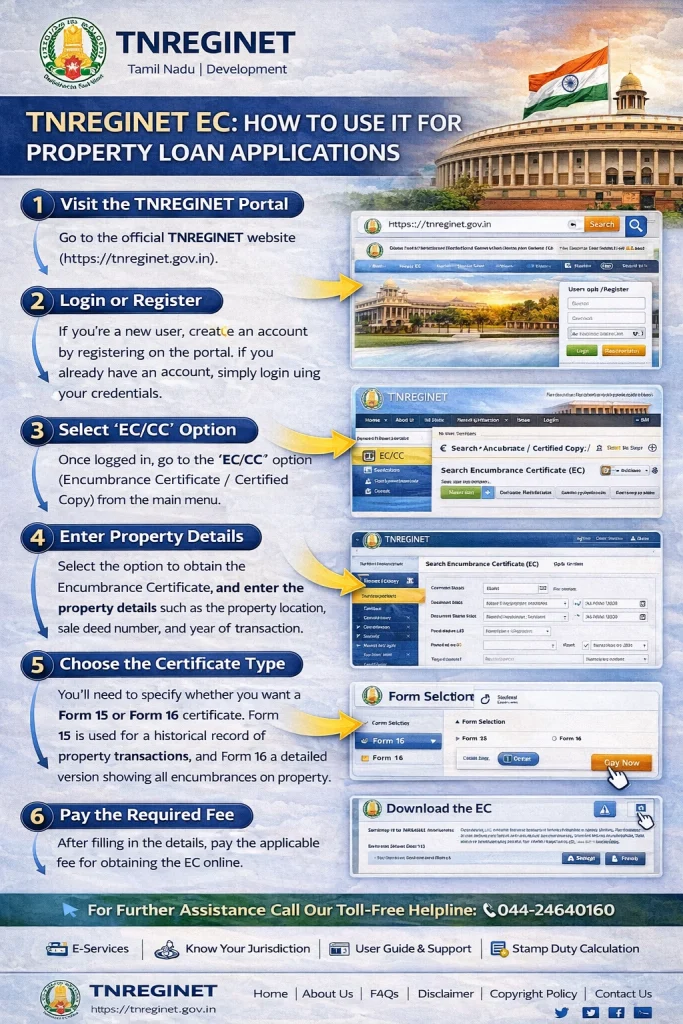
Visit the Official TNREGINET Portal
Go to tnreginet.gov.in — this is the official site hosted by the Tamil Nadu Registration Department.
Navigate to Encumbrance Certificate
Look for:
E-Services → Encumbrance Certificate → Search/View EC
This begins the process.
Choose Search Option
You’ll see options like:
- Property-wise (survey plot)
- Document-wise (if you know a deed number)
- Plot/Flat-wise
Pick whichever helps you find your property faster.
Enter Property Details
Fill in:
- Zone & district
- Sub-Registrar Office (SRO)
- Village or town
- Survey number and subdivision
- Start & end dates for the period you want the EC for
From my experience, banks usually want EC for at least 15–30 years — so make sure your date range covers what they ask.
Enter CAPTCHA & Search
Click Search after filling out everything. The portal will show your EC details on screen.
Download Your EC
Once your EC appears, you can download it as a PDF. This is what you’ll use for bank submission.
If you need a certified, digitally signed copy (which many banks will want), you may need to follow the “Apply & Pay” option on the portal instead of just the free search.
Tips for Loan Applications
Use the Right Date Range
Banks often want ECs for a long period (like 15–30 years). Short periods may delay approval.
Check Before Applying
If your EC shows a mortgage, you can plan to clear it before applying. This smooths the loan process.
Check Before Applying
Banks may require a QR-coded, digitally signed EC — not just a screenshot. Always download the official PDF.
Keep Details Handy
Before you start, gather:
Survey number
Village / town
Sub-Registrar Office
Date range
ID proof (if applying for certified EC)
Common Mistakes to Avoid
Incorrect survey number → No search results
Wrong date range → Incomplete EC
Using a free preview instead of certified copy → Bank won’t accept it
Getting these right makes your loan process quicker and stress-free.
FAQs
Final Words
Getting an Encumbrance Certificate (EC) from TNREGINET is an easy yet crucial step in securing a property loan in Tamil Nadu. By following the steps outlined above and avoiding common mistakes, you can ensure a smoother, quicker loan application process.
By keeping your EC documents clean and up to date, and following the right procedure, you’ll not only meet the bank’s requirements but also ensure that your property has no legal issues hidden in the background. Now that you know the steps, tips, and answers to common questions, applying for a loan using your property should be a breeze!