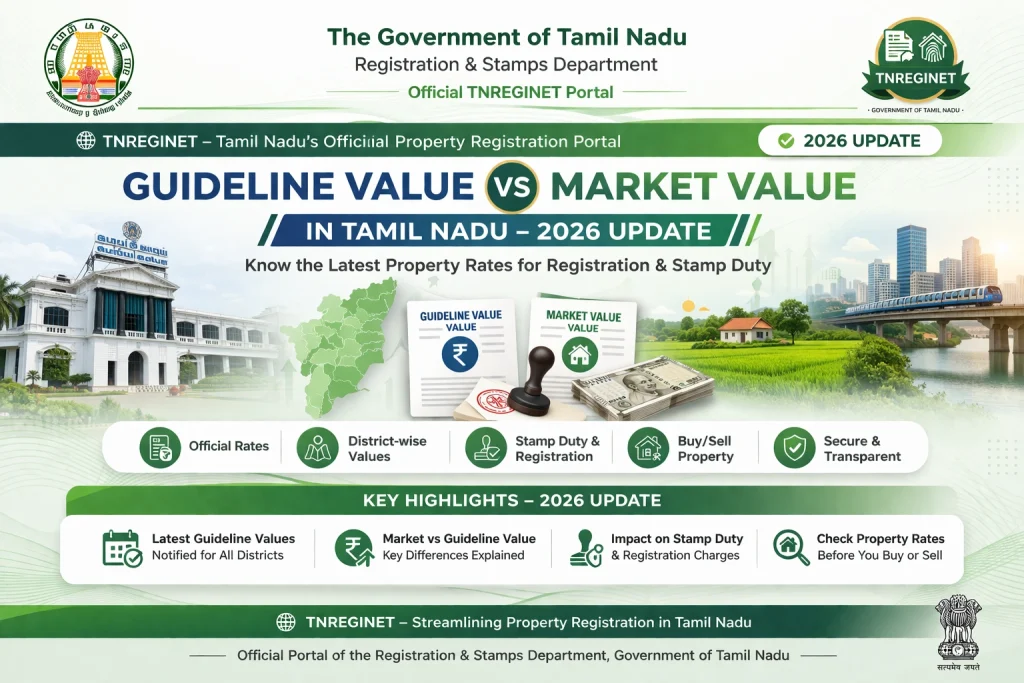
Guideline Value vs Market Value in Tamil Nadu Update (2026)
If you are buying or selling property in Tamil Nadu, these two terms can feel confusing at first. But the difference is actually simple.
Guideline value is the government benchmark for a property in a particular area.
Market value is the real price a buyer is ready to pay and a seller is ready to accept.
Both matter, but they do not mean the same thing. TNREGINET shows the guideline value online, while the market value is what the property is really worth in the current market.
Quick Check
In Tamil Nadu, guideline value is the government-fixed reference value used in registration-related valuation checks, while market value is the actual value of the property in a live sale situation. TNREGINET helps you check the guideline value online, but market value depends on real demand, location, road access, property condition, nearby sales, and negotiation.
What is guideline value?
Guideline value is the minimum benchmark value fixed by the state for a property in a given area. ClearTax’s TNREGINET guide explains it as the value fixed by the Tamil Nadu government below which properties cannot be registered in that area, and the official TNREGINET portal provides a public Guideline Search using Street or Survey Number.
You can also read: TNREGINET Apartment Guideline Value Guide Update 2026
What is market value?
Market value is the real-world value of the property at the time of sale. It is shaped by what buyers are willing to pay and what sellers are willing to accept. The Tamil Nadu Registration Department’s policy notes say that if the registering officer believes the value shown in a document is too low, the matter can be referred so the correct market value can be determined by the Collector (Stamps). That tells you something important: market value is the real valuation question, not just the number shown in the portal.
The simple difference
Think of it like this:
A property in a fast-growing area may have a much higher market value than its guideline value. Housing’s report on the 2024 revision notes that guideline values were updated from July 1, 2024, and in places like Chennai some values increased by more than 10%, yet even then market prices in many areas can still differ from the benchmark.
Why the two values are often different
This is where most people get confused. A property’s market value can be higher because of things like:
Guideline value, on the other hand, is a government-set area benchmark and is revised through an official valuation process. Tamil Nadu’s 2025 Gazette also shows that the state continues to amend the rules for estimation, publication and revision of market value guidelines of properties, which reinforces that guideline value is an official administrative benchmark, not a live bargaining price.
Which one matters during registration?
For a sale deed, the published Tamil Nadu fee schedule lists 7% stamp duty and 4% registration fee on the market value of the property. At the same time, the guideline value remains important because it acts as the government’s reference point when checking whether a property appears undervalued. If the registering officer believes the value shown is too low, the case can be referred for market-value determination.
Which one matters when buying property?
For a buyer, both matter, but for different reasons.
Market value matters because it tells you whether the deal is fair.
Guideline value matters because it helps you estimate registration-related costs and check the government benchmark for that area. ClearTax and Housing both describe guideline value as an important number for property registration planning, while market value reflects what the property can actually command in a real deal.
Easy example
Let’s say a plot has a guideline value of Rs 3,500 per sq ft on TNREGINET, but because it is on a wider road in a popular area, buyers in that locality are paying Rs 5,000 per sq ft.
In that case:
So if you only look at TNREGINET, you may think the property is cheap. But if you only listen to brokers, you may miss the official benchmark. The smart move is to check both. This difference is exactly why Housing and ClearTax treat guideline value as a benchmark and not as the full live market price.
Can market value be lower than guideline value?
It can happen in a weak market, in a distress sale, or when a property has legal or physical issues. But that does not mean the lower private deal value will automatically control registration. Tamil Nadu’s published fee rules and policy notes make it clear that the department can examine undervaluation and determine the correct market value if needed.
How to check guideline value on TNREGINET
TNREGINET makes the guideline-value part easy. The public portal shows Guideline Search and lets users search by:
The portal also says the search is available from 2002.
Can you check market value online the same way?
Not in the same simple way. TNREGINET gives you the guideline value. Market value usually needs a broader look at current sale trends, comparable nearby deals, property features, and sometimes official determination if the value in a document is questioned. That is why the department’s policy notes talk separately about the authority determining the correct market value in undervaluation cases.
Which one should you trust more?
Do not treat this as choosing one and ignoring the other.
Trust guideline value for:
Trust market value for:
The smartest buyers use both together.
Common mistake people make
The most common mistake is assuming the TNREGINET number is the same as the actual property price. It is not. Another common mistake is the opposite one: ignoring TNREGINET completely and trusting only a broker’s quote. Both are risky. Housing’s 2024 report and TNREGINET’s own structure show that the official benchmark and the live market can move differently.
Simple tips before you buy
Check the guideline value on TNREGINET first. Then compare it with actual asking prices in the same area. If the gap is very large, ask why. Maybe the property has better location features, or maybe the seller is overpricing it. If the declared value looks too low for registration, remember that the department can question it.
FAQs
Final Words
The easiest way to understand it is this: guideline value is the government number, market value is the real market number. One helps with registration planning. The other helps with the actual deal. If you are buying property in Tamil Nadu, do not depend on only one of them. Check TNREGINET for the official benchmark, then compare that with the real price trend in the area before you decide.