How Accurate Are TNREGINET EC Records for Property Transactions?
Buying property is exciting, but it can also feel risky. One small mistake in property records can create big trouble later. That is why many buyers in Tamil Nadu check the Encumbrance Certificate, also called EC, through the TNREGINET portal before making a deal.
How accurate are TNREGINET EC records for property transactions?
How accurate are TNREGINET EC records for property transactions?
The simple answer is: TNREGINET EC records are useful and generally reliable for checking registered property transactions, but they should not be treated as the only proof before buying a property. They are a strong starting point, not the final safety check.
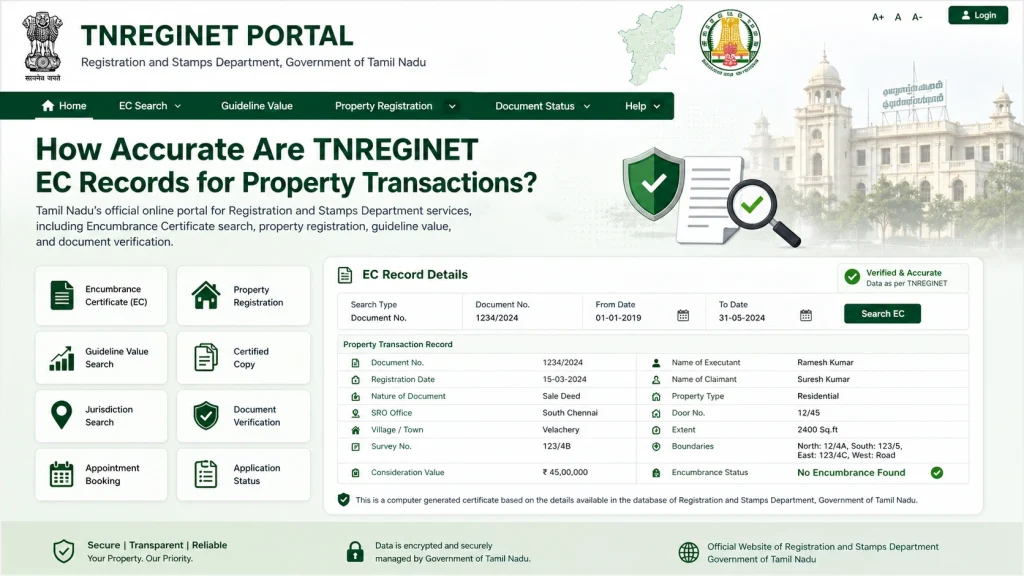
TNREGINET is the official portal of the Tamil Nadu Registration Department. The portal provides services such as View EC, Search/View EC, Document Status, Certified Copy, Guideline Value, and Know Your Jurisdiction. The official site also shows “View/Download Encumbrance Certificate @ Free of Cost,” which makes it helpful for property buyers and owners.
You can also read: Missing EC Data: What to Do When Data Missing on TNREGINET
What Is a TNREGINET EC Record?
A TNREGINET EC record shows registered transactions linked to a property for a selected period. It may include details such as sale deeds, mortgage deeds, gift deeds, release deeds, settlement deeds, and other registered transactions.
In simple words, an EC helps you check whether a property has any registered financial or legal burden. For example, if a property was mortgaged to a bank and that mortgage was registered, it may appear in the EC.
But remember one thing: EC only shows what is available in registration records for the details and period you search.
That means the result depends on the information you enter, such as:
The National Government Services Portal says that users need details such as name, address, zone, district, SRO, street name, village, house details, extent, and boundaries to apply online for an EC in Tamil Nadu.
Quick Answer: Are TNREGINET EC Records 100% Accurate?
No, TNREGINET EC records should not be treated as 100% complete proof of safe ownership.
They are accurate for checking many registered transactions, but they can miss things if:
Even the official TNREGINET website includes a disclaimer saying its contents are prepared with due care and reference to Acts and Rules, but the department cannot be held responsible for errors or omissions, and the website contents are informative in nature.
So, use TNREGINET EC as an important verification tool, but do not depend on it alone.
What TNREGINET EC Records Are Good For
TNREGINET EC records are helpful in many situations.
They can help you check:
| What You Want to Know | How EC Helps |
|---|---|
| Previous registered transactions | Shows sale, gift, mortgage, release, or other registered entries |
| Loan or mortgage history | May show registered mortgage or deposit of title deed |
| Property transfer history | Helps trace registered ownership movement |
| Buyer safety | Gives a basic idea of whether the property has registered encumbrances |
| Bank loan process | Banks often ask for EC during property loan verification |
| Seller claim check | Helps compare seller’s claim with registration records |
This is why buyers, sellers, lawyers, and banks often check EC before moving forward.
Where TNREGINET EC Records Can Go Wrong
This is the part many normal articles do not explain clearly.
TNREGINET EC records may not give the full picture in every case. Here are the main limitations.
Wrong Property Details Can Give Wrong Results
If you enter the wrong survey number, subdivision number, village, SRO, or street name, the EC result may not show the correct transactions.
For example, Survey No. 125/1 and 125/2 may belong to different portions of land. If you search only one number, you may miss records linked to the other subdivision.
Tip: Always copy property details from the sale deed, parent deed, patta, or approved layout documents before searching.
Short EC Period Can Hide Old Transactions
If you check EC only for the last 5 years, you may miss an older mortgage, settlement, partition, or ownership transfer.
For property buying, many people check at least 13 years. In higher-value deals, buyers often ask an advocate to check a longer period.
Tip: Do not search only recent years when buying property. A longer search gives a better picture.
EC May Not Show Unregistered Agreements
An EC mainly reflects registered transactions. If there is an unregistered sale agreement, family dispute, private loan, oral claim, or possession issue, it may not clearly appear in the EC.
This is why a “clean EC” does not always mean the property is completely risk-free.
Data Entry Errors Can Happen
Sometimes names, survey numbers, boundaries, door numbers, or spelling may vary across documents.
For example:
- “Ramesh Kumar” may appear as “Ramesh K.”
- old door number may differ from new door number,
- survey number may have subdivision changes,
- village name may be entered differently.
Small differences can create confusion during search.
Tip: Match EC details with the sale deed, parent deed, patta, tax receipt, and physical property details.
Online Records May Not Replace SRO Verification
TNREGINET is very useful, but for serious property transactions, especially old land or disputed property, it is safer to verify with the concerned Sub-Registrar Office.
The official TNREGINET site includes “Know Your Jurisdiction,” where users can search by street name or village name to identify the relevant jurisdiction.
TNREGINET EC Accuracy: Simple Rating Table
| Area | Accuracy Level | Buyer Should Do |
|---|---|---|
| Registered sale/mortgage entries | Usually good if details are correct | Cross-check with document number and year |
| Recent online EC search | Helpful and fast | Use correct SRO, village, survey number |
| Old property history | May need extra checking | Visit SRO or ask a property lawyer |
| Unregistered claims | Not fully reliable | Do legal due diligence |
| Court dispute check | EC alone is not enough | Check court/lawyer records |
| Ownership proof | EC is supporting proof, not final proof | Verify title deed and parent documents |
Does a Clean EC Mean the Property Is Safe?
Not always.
A clean EC means there may be no registered encumbrance found for the searched details and period. It does not automatically prove that:
Think of EC like a medical test report. It is important, but a doctor may still need other tests before giving final advice.
In the same way, EC is important, but a buyer should still check other property documents.
Documents to Check Along With TNREGINET EC
Before buying property in Tamil Nadu, check these documents along with EC:
TNREGINET also provides guideline value search, and its official page shows search fields such as district, SRO, village, street name, and survey number. It also mentions guideline value search from 2002.
When Should You Not Rely Only on TNREGINET EC?
Do not rely only on EC if:
In these cases, get help from a document writer, advocate, or the concerned SRO.
What If TNREGINET EC Shows “No Records Found”?
“No Records Found” does not always mean the property has no transactions. It may happen because:
Try again with correct details from the sale deed. Also search using document-wise details if you have the document number, year, and SRO.
Best Way to Use TNREGINET EC Before Buying Property
Here is a simple step-by-step method:
Step 1: Collect Property Details
Take details from the latest sale deed or parent deed. Do not guess the survey number or SRO.
Step 2: Search EC on TNREGINET
Use the official TNREGINET portal and choose EC search/view option.
Step 3: Select a Proper Date Range
For buying property, avoid checking only a short period. Choose a longer period to understand transaction history better.
Step 4: Match EC With Documents
Compare EC entries with sale deed, parent deed, patta, and tax records.
Step 5: Check Guideline Value
Use the guideline value section to understand the government-fixed value for that area.
Step 6: Check Certified Copy if Needed
If you are unsure about any registered document, apply for or verify a certified copy.
Step 7: Take Legal Opinion
Before paying advance or signing an agreement, ask a property lawyer to verify the complete title chain.
FAQs
Final Words
TNREGINET EC records are accurate and helpful for checking registered property transactions, but they are not enough by themselves for a safe property purchase.
They are best used as a first-level verification tool. A clean EC gives confidence, but it should always be checked with sale deeds, parent documents, patta records, guideline value, certified copies, and legal advice.
So, before buying property in Tamil Nadu, use this simple rule:
Check TNREGINET EC first, but verify the full property file before paying money.
That one extra step can save you from a costly mistake.