Why TNREGINET Guideline Value Looks Wrong Update (2026)
If the TNREGINET guideline value looks wrong, you are not alone. Many people check the value online and feel something is off right away. Sometimes the number looks too low. Sometimes it looks too high. Sometimes it does not match what a broker, seller, or neighbor told you. In many cases, the portal is not actually wrong. The problem is usually the way the value is being compared, searched, or understood. The official TNREGINET portal itself shows that guideline value depends on the exact Street or Survey Number search path and the correct District, Sub Registrar Office, and Village details.
Quick Check
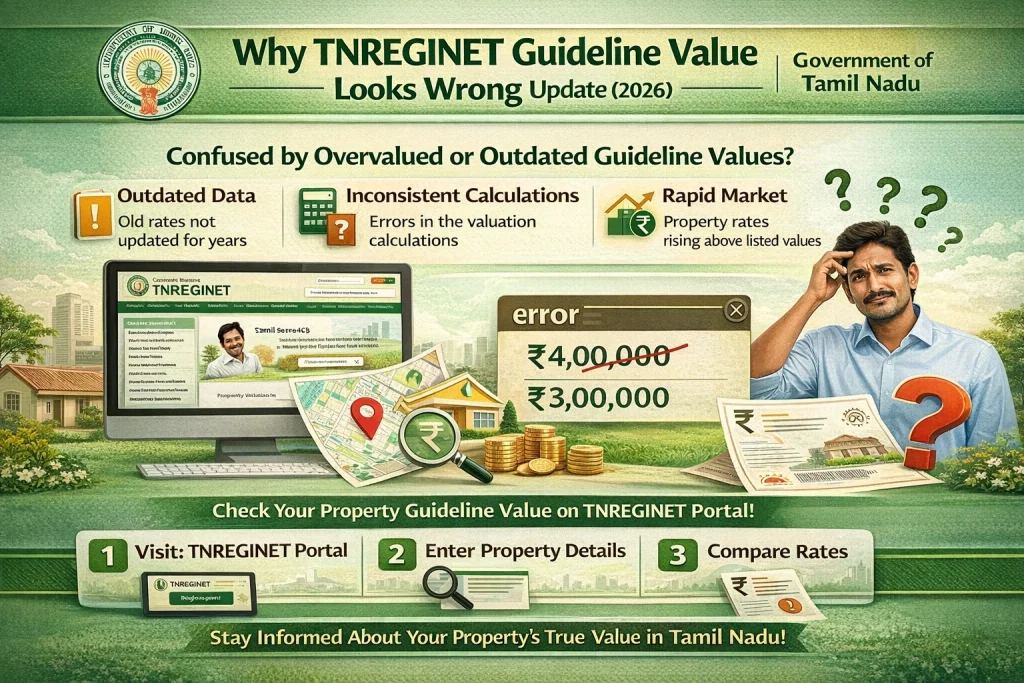
TNREGINET guideline value usually looks wrong for one of these reasons: you searched the wrong SRO or village, you used the wrong search type, you are comparing guideline value with market price, your property falls under a different subdivision or classification, or the value has a different effective date than you expected. TNREGINET’s official search setup and real indexed result pages support all of these possibilities.
First, understand one important thing
Guideline value is not always the same as market value. It is a government-fixed benchmark used for registration purposes. ClearTax and Housing both explain that the actual transaction value can be higher, and stamp duty or registration calculations are generally based on the higher of the actual value or the guideline value. So if you compare TNREGINET with what a broker says the property is worth in the open market, the portal can look “wrong” even when it is doing exactly what it is supposed to do.
You can also read: How to Check Street Guideline Value on TNREGINET Update 2026
You are comparing guideline value with market price
This is the most common reason. A seller may quote a much higher market price because of road access, demand, nearby development, apartment potential, or local negotiation. But TNREGINET shows the government benchmark used for registration, not the full live market mood of the area. Housing explicitly notes that guideline value is often lower than market value, and ClearTax explains it as the minimum value fixed for registration in that area.
You selected the wrong SRO
The portal requires the correct Sub Registrar Office for the search. If you choose the wrong office, the result may be blank, misleading, or tied to a different locality than the one you meant to check. The TNREGINET homepage itself prominently shows Know Your Jurisdiction, which is a strong hint that users often get stuck at this step.
You used Street search when Survey Number search was the better option
Tamil Nadu guideline values are not all organized the same way. ClearTax says values are generally fixed street-wise in well-developed areas and survey-number-wise for lands or properties that are not formed into streets. So if you search a land parcel through the street path, or a developed plotted area through the wrong survey path, the result may look incomplete or odd.
Your survey number or subdivision is not exact
This is a big one. The indexed TNREGINET result pages show multiple entries under the same base survey number, each with separate subdivision numbers and sometimes different effective dates. That means survey number 37 is not automatically the same as 37/6, 37/9A, or 37/2A1B. If you compare one subdivision with another, the value can look wrong even though the portal is showing the correct entry for that exact record.
You are looking at a value from a different date
The TNREGINET homepage says guideline value search is available from 2002, and official result pages can show different start dates for different entries. For example, indexed results include effective dates like 01-Jul-2024, 30-Oct-2024, and 01-Apr-2025 for entries within the same broader search result. So the number may look wrong simply because you are comparing it with an older or newer revision.
The area was revised recently
Housing reports that revised guideline values in Tamil Nadu took effect on July 1, 2024, with increases in Chennai and some old corporations, while other areas remained unchanged. So people often compare an old memory, an older screenshot, or an old deed with a newer TNREGINET result and assume the current value is wrong.
Your property type or land classification is different
Official indexed result pages for guideline search include land classification in the results. That matters. Two properties in the same broad area can carry different value logic if one is classified differently from the other, or if one sits on a better-located subdivision. This is another reason a neighbor’s rate and your searched rate may not match exactly.
The portal result is correct, but your local comparison is not
Many people compare the TNREGINET value with:
That comparison can be misleading. Guideline value is a registration benchmark, not a live asking-price board. ClearTax and Housing both explain guideline value in that limited but important registration context.
You found an outdated article or old screenshot online
Some competitor articles still describe older TNREGINET flows, older revision periods, or old screenshots. But the current official homepage clearly shows a direct Guideline Search box with Street and Survey Number options and says the search covers values from 2002. When users follow old screenshots, they often think the current value is wrong when the real problem is that the portal has changed.
You may really need a correction or local verification
Sometimes the value may genuinely need review, especially if the entry appears to mismatch approved records or nearby comparable official entries. Housing says owners or buyers can file a correction petition before the jurisdictional Joint Sub-Registrar or District Registrar with supporting documents. I could not verify a clearly surfaced public online correction form for this directly on TNREGINET’s current homepage, so the safer advice is to verify the jurisdiction first and then approach the concerned registration authority with documents.
What to do if the guideline value looks wrong
Start simple. Check the correct SRO first. Then search again using the exact village and the right path, either Street or Survey Number. Match the survey number and subdivision with your deed. Look at the effective date. Compare the result with the property’s exact classification, not with a random nearby quote. If it still looks off, collect your sale deed, layout approval, tax records, and other proof and take them to the jurisdictional office. That approach matches both the official portal structure and the dispute/correction guidance summarized by Housing.
Simple example
If your land is in a fast-growing area and a broker says it is worth Rs 5,000 per sq ft, but TNREGINET shows Rs 3,200, that does not automatically mean the portal is wrong. It may mean:
That is why this keyword deserves its own article. Most people are not asking for a definition. They are really asking, “Why does this number not match what I expected?” That expectation gap is visible in the way official data and competitor explainers line up.
FAQs
Final Words
If TNREGINET guideline value looks wrong, the issue is usually not a random portal error. Most of the time it comes down to the wrong comparison, wrong search method, wrong office, wrong subdivision, or wrong date. Once you treat guideline value as a government registration benchmark instead of a live market quote, the result makes much more sense. Then, if it still looks off after checking the exact details, take the papers to the correct registration office and ask for local verification.