Compare Market Value vs Guideline Value in Tamil Nadu – 2026
When buying, selling, or registering property in Tamil Nadu, you may notice two different property values: Market Value and Guideline Value. Understanding the difference is essential for calculating taxes, negotiating deals, and planning property investments.
This guide explains the key differences, how to compare them, and practical tips for using TNREGINET effectively.
What Is Market Value
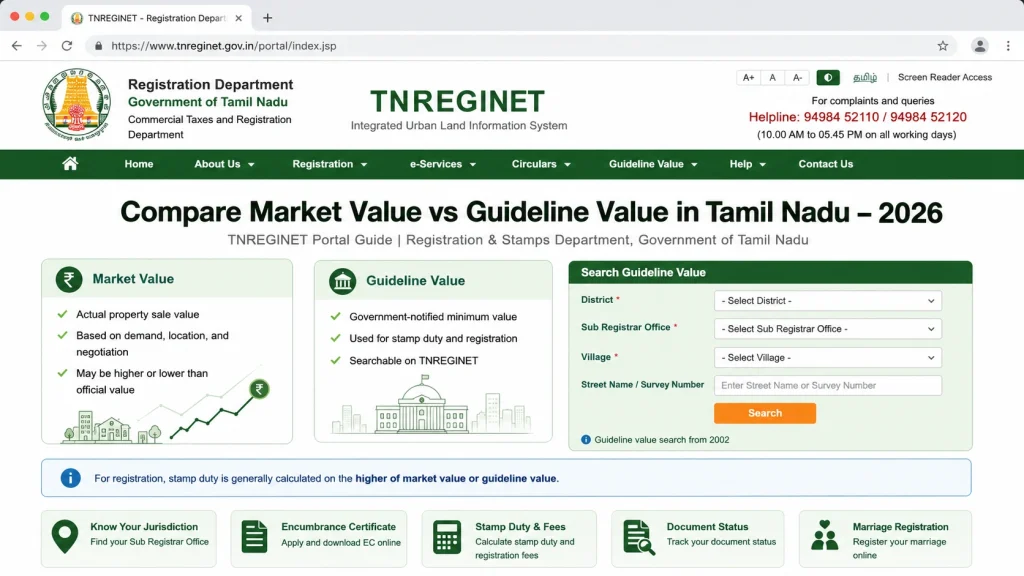
Market Value is the price that a buyer and seller agree on during a transaction.
You can also read: TNREGINET Circle Rate vs Guideline Value Explained 2026
What Is Guideline Value
Guideline Value is the official minimum value per square foot set by the Tamil Nadu Registration Department for stamp duty and registration charges.
Key Differences Between Market Value and Guideline Value
Compare Market Value vs Guideline Value in Tamil Nadu:
| Feature | Market Value | Guideline Value |
|---|---|---|
| Determined by | Buyer & seller agreement | Government notification, SRO records |
| Purpose | Actual sale price | Tax and registration calculation |
| Flexibility | Can be higher or lower than guideline value | Fixed as per government rules |
| Affects Bank Loan | Yes | No direct effect on loans |
| Legal Requirement | Not legally mandatory | Mandatory for registration and stamp duty |
| Update Frequency | Varies with market | Periodic government updates |
How to Compare Market Value and Guideline Value
Find Guideline Value
Use TNREGINET portal’s Guideline Value Search. Enter district, SRO, survey/street number, and property type. Note the rate per sq ft.
Determine Market Value
Check actual sale deeds, recent transactions, or property listings. Consult real estate agents if needed.
Compare Values
If Market Value > Guideline Value → Stamp duty will be calculated on Market Value.
If Market Value < Guideline Value → Stamp duty will be calculated on Guideline Value.
Example:
Tips for Using TNREGINET
Troubleshooting Common Issues
| Issue | Cause | Solution |
|---|---|---|
| Guideline value not matching market trends | Market fluctuation vs government update | Use the latest government notification |
| Portal shows old values | Cache or synchronization delay | Clear browser cache or check after 24–48 hours |
| Market value unknown | No recent sale or unlisted property | Consult local real estate agents or survey records |
| Confusion during tax calculation | Using wrong higher value | Always compare and take the higher of the two |
| Survey number errors | Wrong SRO or district input | Verify property details before search |
FAQs
Final Words
Comparing Market Value and Guideline Value in Tamil Nadu is essential for accurate tax calculation, legal compliance, and smart property deals. Always use the higher value for stamp duty, verify both values before finalizing a sale, and keep records for future reference.
Understanding these differences helps you negotiate better, plan finances, and avoid legal surprises when registering property.