Check Property Value History in TNREGINET – Easy 2026 Guide
If you want to see how the value of a property has changed over time in Tamil Nadu, the TNREGINET portal lets you check the property value history through transaction records. This is useful when you’re planning to buy, sell, or estimate prices based on past trends.
This guide shows you how to check property value history on TNREGINET, what it means, and how to fix common issues when searching.
What Is Property Value History
Property value history refers to the past sale values and registered transactions of a property over time. It helps you understand:
This is especially helpful when negotiating price or estimating future value.
You can also read: Compare Market Value vs Guideline Value in Tamil Nadu – 2026
Why Property Value History Is Useful
Knowing the history helps you:
When you know history, you avoid guessing and make data‑driven decisions.
Step‑by‑Step: How to Check Property Value History on TNREGINET
Here is the easiest way to view the history of your property’s registered values:
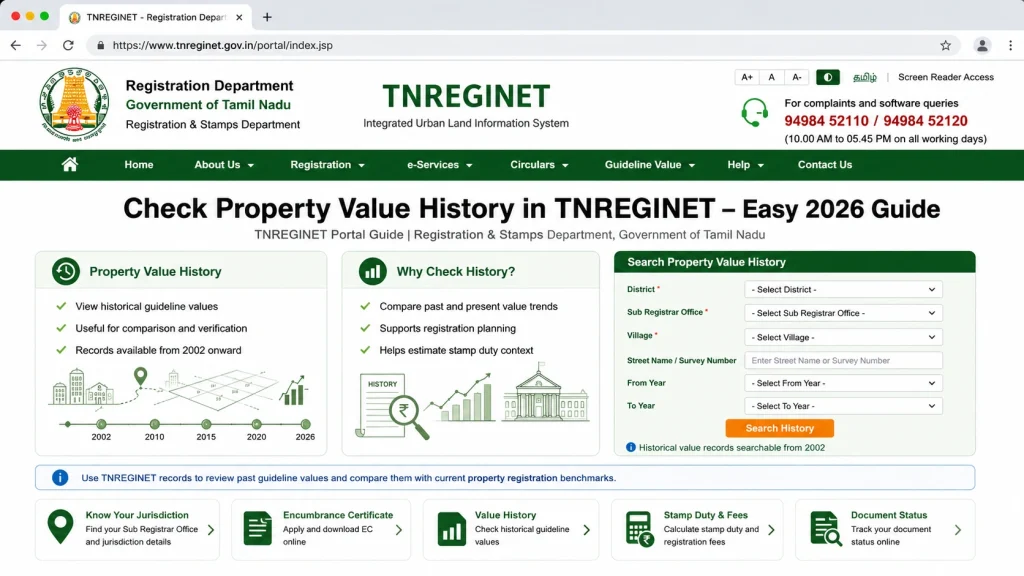
Step 1: Open the TNREGINET Portal
Open your browser and go to the TNREGINET portal.
Step 2: Find EC (Encumbrance Certificate) Search
Look for the Encumbrance Certificate (EC) Search section.
Step 3: Choose Search Type
You can search history in two ways:
Document Number–Wise Search
Survey Number–Wise Search
Both give you past transactions linked to the property.
Step 4: Fill in Property Details
Enter the required fields:
Date range (if needed)
District
Sub‑Registrar Office (SRO)
Survey number (or Document number)
Step 5: Click Search
Click Search to see all registered transactions.
Step 6: Review the List
You will see a list of past transactions with dates and values. These are the official market values used in each sale.
Example Table: Property Value History
| Year | Transaction Type | Sale Value (₹) | Market Trend Indicator |
|---|---|---|---|
| 2018 | Sale Deed | 35,00,000 | Increasing |
| 2020 | Sale Deed | 42,50,000 | Growing |
| 2022 | Sale Deed | 48,00,000 | Steady Growth |
| 2024 | Sale Deed | 55,00,000 | Continuing Rise |
This example helps you visualize how the property’s value changed over time.
Tips for Accurate History Search
Troubleshooting Common Issues
| Problem | Likely Cause | What to Do |
|---|---|---|
| No records found | Wrong survey or document number | Recheck and try again |
| Search takes too long | Portal load or slow internet | Try during off‑peak hours |
| Partial history displayed | Narrow date range used | Use a wider date range |
| Entries look incomplete | Some transactions may not be digitized | Visit local SRO for full archives |
| Incorrect values shown | Typos in input or wrong SRO selected | Double‑check all details accurately |
Why History and Guideline Value May Differ
So history reflects what people actually paid, while guideline value is a base rate for taxes.
FAQs
Final Words
Checking property value history on TNREGINET gives you real insights into how a property’s price has changed over time. It helps in negotiation, planning, and decision‑making. Just make sure you enter correct details, use a wide date range, and double‑check your search entries.
Getting history data gives you confidence and helps avoid surprises when finalizing property deals or estimating future value trends.