TNREGINET Form 15 and Form 16 EC Meaning for Property Buyers
When you download an Encumbrance Certificate, or EC, from TNREGINET, you may see it issued as Form 15 or Form 16. Many Tamil Nadu property buyers get confused here. Some think Form 16 means income tax Form 16. Some think Form 15 means the property has a problem. Some believe Form 16 means the property is 100% safe.
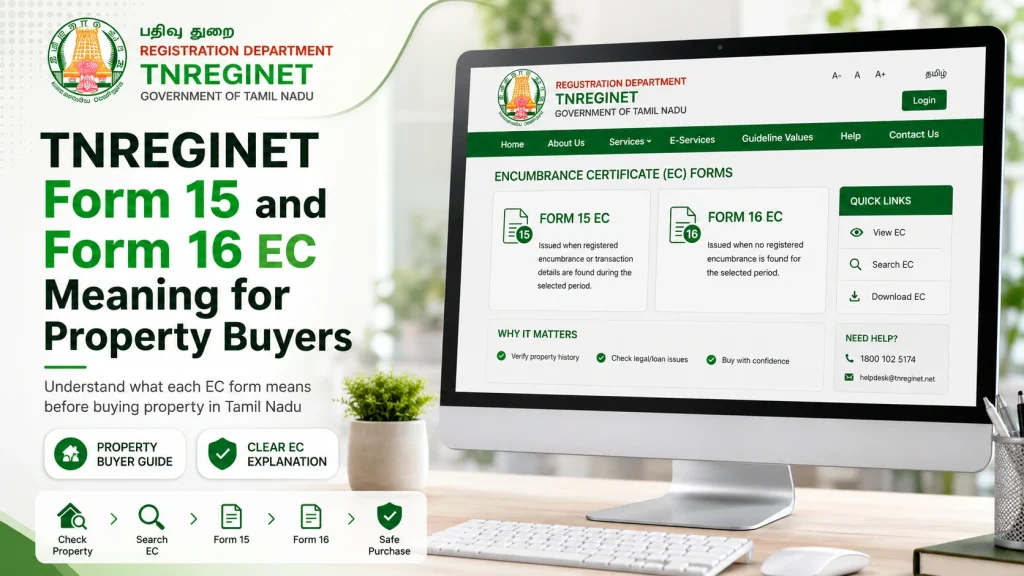
The truth is simple. In property EC, Form 15 and Form 16 are two types of Encumbrance Certificates. Form 15 is issued when registered transactions are found for the property during the selected period. Form 16 is issued when no registered encumbrance is found for the selected period. In Tamil Nadu, users can view and download EC through the official TNREGINET portal, which lists View/Download Encumbrance Certificate @ Free of Cost as a service.
This guide explains the meaning of TNREGINET Form 15 and Form 16 EC in simple words, especially for Tamil Nadu property buyers who want to avoid legal, loan, or ownership problems before buying land, a house, or a flat.
What Is Form 15 and Form 16 EC?
Form 15 EC means the property has registered transactions during the selected period, such as sale, mortgage, gift, lease, partition, or settlement. Form 16 EC means no registered encumbrance was found for the property during the selected period. Form 16 is also commonly called a Nil Encumbrance Certificate.
You can also read: How to View and Download TNREGINET EC Online for Free in 2026
What Is an EC in TNREGINET?
An Encumbrance Certificate is a property document that shows registered transactions related to a property for a particular time period.
It helps buyers check whether a property has:
TNREGINET is the official Tamil Nadu Registration Department portal. Its homepage includes eServices → Encumbrance Certificate → View EC, along with other services like guideline value search and document status.
What Is Form 15 EC in TNREGINET?
Form 15 EC is issued when the property has registered transactions during the period you searched.
This does not always mean the property is bad. It simply means the property has some registered activity.
For example, Form 15 may show:
For a buyer, Form 15 is useful because it shows the transaction history of the property.
Example of Form 15 EC
Suppose you search EC for a land from 2010 to 2026.
If the property was sold in 2014 and mortgaged in 2018, the EC may come as Form 15.
That Form 15 may show:
| Detail | Example |
|---|---|
| Document Type | Sale Deed |
| Year | 2014 |
| Parties | Seller and Buyer Names |
| Property Details | Survey Number, Village, SRO |
| Later Entry | Mortgage in 2018 |
This helps you understand what happened to the property during that period.
Does Form 15 Mean the Property Has a Problem?
No. Form 15 does not automatically mean the property has a legal problem.
It only means that registered transactions exist.
A property can have Form 15 because it was legally sold earlier. That is normal.
But buyers should carefully check whether:
So, Form 15 is not bad by itself. It is a document that needs careful reading.
What Is Form 16 EC in TNREGINET?
Form 16 EC is issued when no registered encumbrance is found for the selected property and selected time period.
It is also called a Nil Encumbrance Certificate.
In simple words, Form 16 means the system did not find any registered sale, mortgage, loan, gift, settlement, partition, or other encumbrance for that property during the period you selected. Form 16 is commonly explained as a nil-encumbrance certificate when no registered encumbrance exists for the period requested.
Example of Form 16 EC
Suppose you search EC for a property from 2020 to 2026.
If no registered transaction happened during this period, the EC may come as Form 16.
That means:
But this does not always mean the full property history is clean. It only speaks about the selected period.
Does Form 16 Mean the Property Is 100% Safe?
No. This is a very important point.
Form 16 does not guarantee that the property is fully safe.
It only means no registered encumbrance was found during the selected period.
Form 16 may not show:
So, Form 16 is a good sign, but it is not the final proof of a safe property.
Form 15 vs Form 16 EC Difference
| Point | Form 15 EC | Form 16 EC |
|---|---|---|
| Meaning | Registered transactions found | No registered encumbrance found |
| Also Called | Encumbrance Certificate | Nil Encumbrance Certificate |
| Shows Transaction Details | Yes | No transaction details for selected period |
| Common Entries | Sale, mortgage, gift, settlement, partition | No registered entries found |
| Is It Bad? | Not always | Not always fully safe |
| Buyer Should Do | Check all entries carefully | Verify other documents also |
| Best Use | Understand property history | Confirm no registered encumbrance for selected period |
Simple Way to Remember
Remember it like this:
That is the easiest way to understand the difference.
Why Property Buyers Must Understand Form 15 and Form 16
Many buyers only download EC and stop there. That is risky.
What Buyers Should Check in Form 15 EC
If your EC is Form 15, check these details carefully:
A mortgage entry without a matching release deed can be a serious issue.
What Buyers Should Check in Form 16 EC
If your EC is Form 16, do not relax immediately.
Check these things:
A wrong search can also produce a “nil” result.
Common Buyer Mistakes
Avoid these mistakes when reading Form 15 and Form 16 EC:
Is Form 16 EC the Same as Income Tax Form 16?
No.
This is a common confusion.
They are completely different documents.
For property buyers in Tamil Nadu, Form 16 EC means Nil Encumbrance Certificate for the selected property and period.
Is Form 15 Required for Home Loan?
Banks usually check EC before giving a home loan. If the EC is Form 15, the bank will review the entries.
Form 15 may be accepted if:
If there is an active mortgage or unclear entry, the bank may ask for clarification or additional documents.
Is Form 16 Better Than Form 15?
Not always.
Many people think Form 16 is always better because it means Nil Encumbrance. But that depends on the property.
For example, if a property was sold recently, you should expect that sale entry to appear. If you get Form 16 instead, it may mean you searched the wrong period, wrong SRO, or wrong survey number.
So, the “better” form depends on the property history.
When Can Form 15 Be a Good Sign?
Form 15 can be a good sign when it clearly shows:
A well-recorded Form 15 can help confirm the chain of title.
When Can Form 16 Be Risky?
Form 16 can be risky if:
So, always verify Form 16 carefully.
Form 15 and Form 16 Meaning in Tamil-Friendly Style
Form 15 meaning:
Property-la registered transaction irukku. Sale, mortgage, gift, settlement, partition madhiri entries EC-la varum.
Form 16 meaning:
Selected period-la registered encumbrance illa. Idha Nil Encumbrance Certificate nu solluvanga.
Important:
Form 16 vandha property 100% safe nu artham illa. Correct survey number, SRO, village, date range ellam check pannanum.
Buyer Checklist Before Trusting EC
Before buying property, check:
EC is important, but it is only one part of property verification.
FAQs
Final Words
For Tamil Nadu property buyers, understanding TNREGINET Form 15 and Form 16 EC is very important.
Form 15 means registered transactions are available for the selected period. It may show sale, mortgage, gift, settlement, partition, or other registered entries.
Form 16 means no registered encumbrance was found for the selected period. It is also called a Nil Encumbrance Certificate.
But neither form should be blindly trusted. Form 15 needs careful reading. Form 16 needs careful verification. Before buying any property, always compare EC with sale deed, parent document, patta, guideline value, and legal opinion.
A few minutes spent understanding EC can save you from serious property problems later.