What Is the Role of Guideline Value in Property Registration?
When buying or selling property in TNREGINET Tamil Nadu, one of the essential factors that come into play is the guideline value. The guideline value is a government-determined minimum value of a property, which is used to assess the amount of stamp duty and registration fees that need to be paid during property transactions. It plays a crucial role in the property registration process and ensures transparency and fairness in property dealings. In this article, we will explore the importance of guideline value in property registration.
What is Guideline Value?
The guideline value is a price set by the government for each type of property in a particular locality. It represents the minimum price at which property transactions can be registered. The value is set based on various factors such as:
Guideline values are updated regularly to keep up with changes in the real estate market and to ensure that the tax system reflects the current property market conditions.
You can also read:Why Is My TNREGINET EC Search Showing No Results? Easy Fixes
Role of Guideline Value in Property Registration
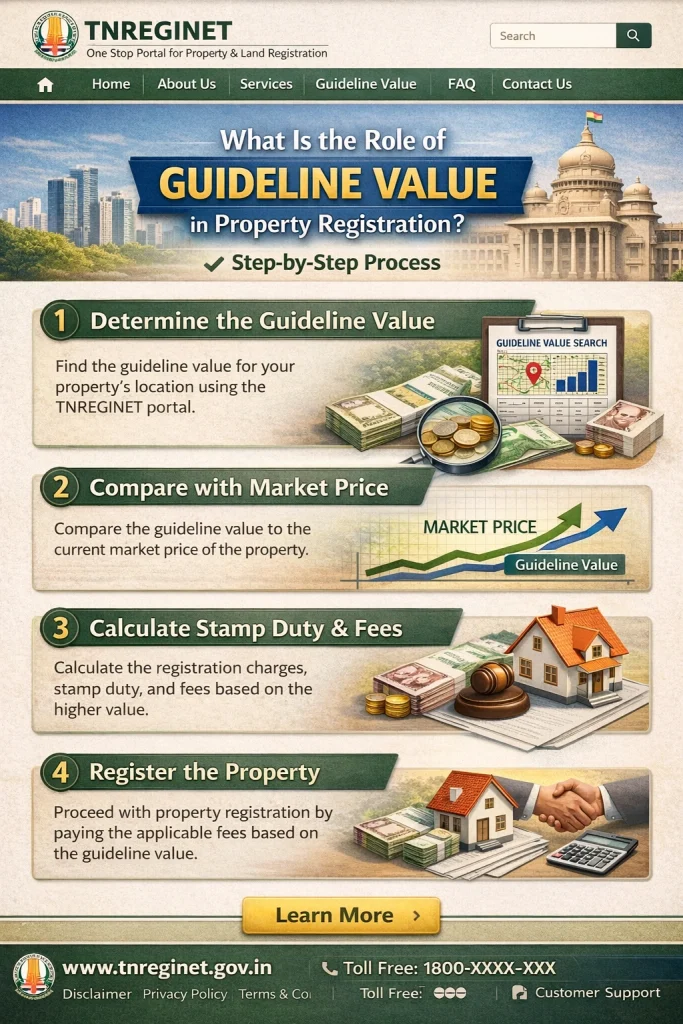
Determining Stamp Duty and Registration Fees
The stamp duty and registration fees for a property transaction are based on the guideline value, not the actual sale value.
For instance, if the guideline value for a property is set at ₹50 lakhs, the stamp duty will be calculated based on this value, even if the property is sold for a lower or higher price.
In Tamil Nadu, the stamp duty rate is usually a percentage of the guideline value. The rates may vary based on the property’s location (urban or rural) and the type of transaction (sale, gift, etc.). Example:
If the guideline value of a property is ₹50 lakhs and the stamp duty rate is 7%, the stamp duty would be ₹3.5 lakhs.
Ensuring Fairness and Transparency in Transactions
The guideline value helps standardize property transactions across the state and ensures that the transaction value is not underreported to evade tax.
Without a guideline value, there could be discrepancies in the property transaction prices, where buyers and sellers could understate the true value of the property for tax purposes.
The guideline value prevents such practices by establishing a minimum price for all properties, which must be adhered to during registration.
Property Valuation for Legal and Financial Purposes
Guideline value plays a vital role in property valuation, especially when the property is used as collateral for loans.
Financial institutions, such as banks, often consider the guideline value when assessing a property for a loan.
The encumbrance certificate (EC), which is a record of property transactions, also relies on guideline values to determine the legitimacy and accuracy of property ownership records.
Resolving Disputes and Legal Matters
In case of property disputes, the guideline value can be used as a benchmark for determining the fair market value of the property.
It is often used in court cases or legal matters to establish the official value of the property.
For example, in inheritance or family disputes, the guideline value can be used to determine the property’s worth for equitable division or tax assessment.
Setting Property Taxes
Property tax is calculated based on the guideline value in many areas.
Local governments use the guideline value to assess taxes for property owners. This ensures that property owners are paying taxes in proportion to the value of their properties, which are determined based on government standards.
Factors Influencing Guideline Value
Several factors influence the guideline value of a property:
Location
Properties in prime locations like city centers or well-developed areas tend to have higher guideline values.
Areas undergoing rapid development or infrastructural projects also see an increase in guideline values.
Property Type
The type of property — residential, commercial, agricultural, or industrial — determines its guideline value. Commercial properties generally have higher guideline values than residential ones.
Market Trends
The guideline value is also influenced by the real estate market trends in a region. For example, if property prices in an area are rising due to demand, the guideline value is likely to follow suit.
Government Policy
Changes in government policies related to urban planning, infrastructure development, and zoning can also affect the guideline value.
FAQs
Final Words
The guideline value plays a critical role in property transactions by ensuring transparency, fairness, and uniformity in the calculation of stamp duty and registration fees. It also helps maintain legal integrity in property transactions and is an essential factor in various financial processes such as loans and property tax calculations.
If you encounter any discrepancies with the guideline value during registration, it’s important to review the details carefully and contact the Sub-Registrar office or TNREGINET support to clarify or resolve the issue.