TNREGINET Guideline Value: Understanding Market vs. Legal
If you’re dealing with property transactions in Tamil Nadu, understanding the difference between Market Value and Guideline Value is crucial. While both are related to the value of property, they serve different purposes and are used in different contexts. The TNREGINET Portal is where you can access the Guideline Value and it plays a vital role in property registration, stamp duty, and legal documentation.
So, what exactly is the difference between Market Value and Guideline Value? Let’s break it down in simple terms so you can navigate the property registration process smoothly.
What is Market Value?
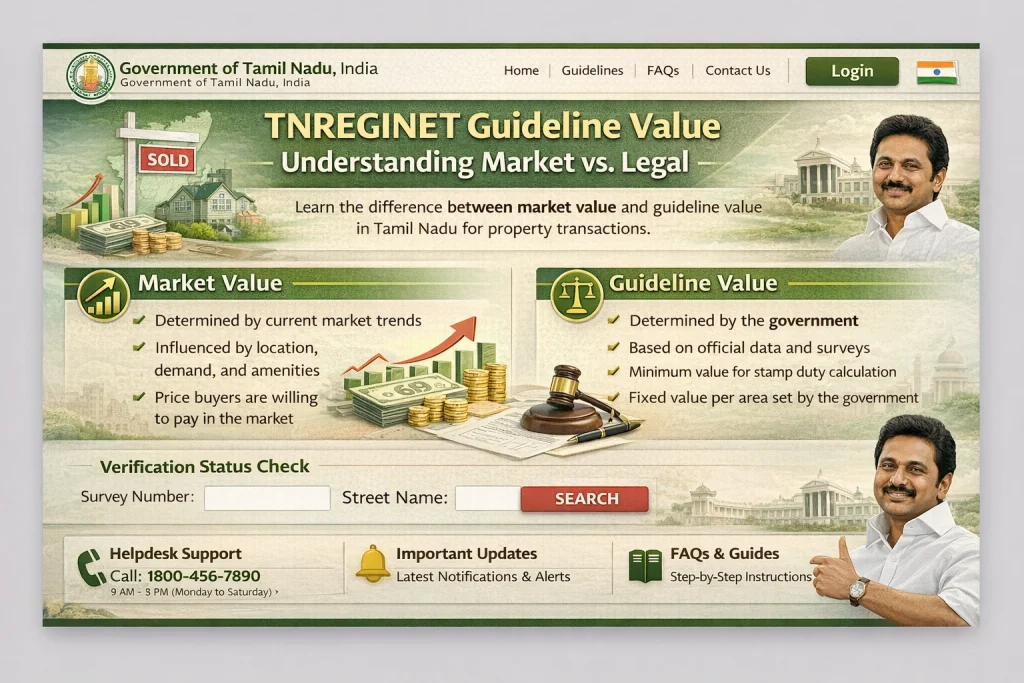
The Market Value of a property is the actual price at which the property is sold in the open market. It reflects the current demand and supply conditions in the area. The market value can fluctuate based on factors such as:
Location of the property (prime locations tend to have higher market value)
Demand and supply in the local real estate market
Infrastructure developments (roads, metro stations, schools, etc.)
Property condition (new properties may have a higher market value than older ones)
Essentially, the Market Value is determined by what a buyer is willing to pay and what the seller is willing to accept.
You can also read: Can You Register Property for Less Than Guideline Value 2026?
What is Guideline Value?
The Guideline Value, on the other hand, is the minimum value fixed by the government for property transactions in a specific area. It is set by the Tamil Nadu government through the Registration and Stamps Department. The Guideline Value is used to calculate stamp duty and registration charges when a property is being registered.
Unlike Market Value, the Guideline Value is not negotiable. It is determined based on several factors, including:
The Guideline Value is typically lower than the market value in most cases.
Key Differences Between Market Value and Guideline Value
Determination Basis
Flexibility
Purpose
Role in Registration
Why Does Guideline Value Matter More than Market Value for Registration?
While the Market Value is the actual price agreed upon by the buyer and seller, the Guideline Value plays a legal role in property registration. Here’s why:
Stamp Duty Calculation: The Guideline Value is used to calculate the stamp duty that the buyer must pay. If the Market Value is higher than the Guideline Value, the stamp duty will be calculated on the Market Value. However, if the Guideline Value is higher, stamp duty will be calculated on that value.
Registration Charges: Just like stamp duty, the registration charges for property transactions are calculated using the Guideline Value. This ensures that the property is registered at a fair and standardized price set by the government.
Transparency: The Guideline Value helps maintain transparency in property transactions. It ensures that the buyer and seller don’t undervalue the property to avoid taxes.
How to Check Guideline Value on TNREGINET?
Checking the Guideline Value of a property in Tamil Nadu is simple using the TNREGINET Portal. Here’s how to do it:
Visit the TNREGINET Portal: Go to the official TNREGINET website (https://tnreginet.gov.in).
Log in: If you have an account, log in using your credentials. If not, you can search for the Guideline Value without logging in.
Enter Property Details: Fill in the property details, such as:
Search for Guideline Value: After entering the details, click on Search to view the Guideline Value for the property.
Download the Certificate: You can also download the Guideline Value certificate for your records or use in property transactions.
When Can You Use Market Value Instead of Guideline Value?
While you generally can’t register property for a price lower than the Guideline Value, you can use the Market Value to:
Determine the Actual Sale Price: The Market Value reflects what the buyer and seller agree upon, and it will usually be the actual price paid during the transaction.
Bank Loan: When applying for a loan, the Market Value of the property is used by banks to assess the loan amount.
However, for registration purposes, the Guideline Value will always be used for calculating stamp duty and registration charges.
FAQs
Final Words
While both Market Value and Guideline Value are important, they serve different purposes. The Market Value reflects the true selling price of the property, whereas the Guideline Value is used to calculate stamp duty and registration charges. It is essential to understand these values before buying or selling property to avoid any surprises when it comes to taxes and registration.
Using the TNREGINET Portal, you can easily access the Guideline Value and check whether it aligns with the Market Value to ensure a smooth property transaction.