Property Price vs Guideline Value Explained Update (2026)
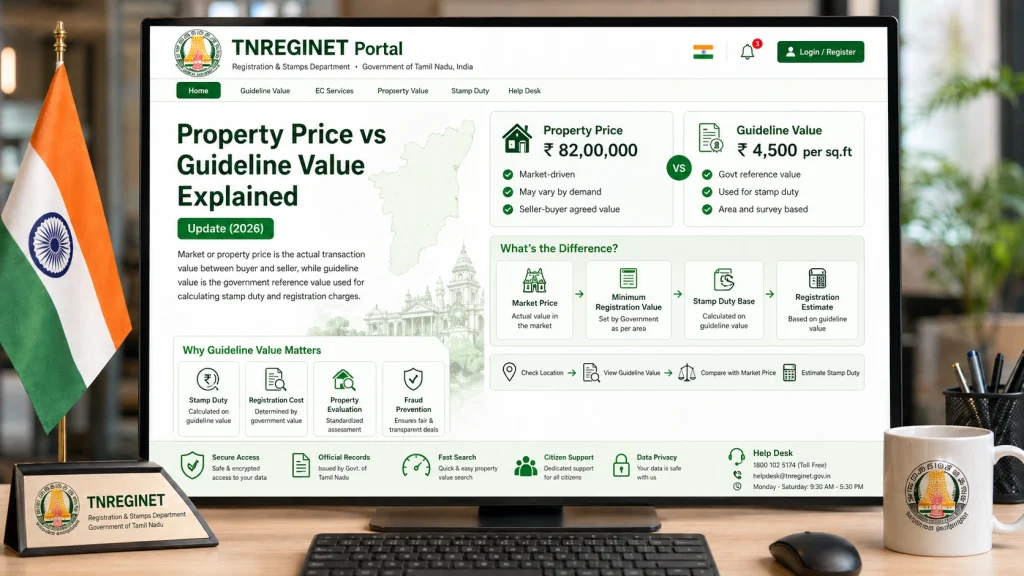
When buying property in Tamil Nadu, you’ll notice two key numbers: the property price agreed with the seller and the guideline value (circle rate) set by the government. Understanding the difference is crucial for stamp duty calculation, bank approvals, and legal compliance.
What Is Property Price?
The property price is the amount agreed between the buyer and seller for the property transaction.
Example: You negotiate a house for ₹60 lakh, that is the property price.
You can also read: How to Use Guideline Value for Stamp Duty on TNREGINET (2026)
What Is Guideline Value?
Guideline value (circle rate) is the minimum value fixed by the government for property in a specific area.
Example: The guideline value for the same house may be ₹55 lakh.
Key Differences Between Property Price and Guideline Value
| Feature | Property Price | Guideline Value |
|---|---|---|
| Definition | Price agreed between buyer & seller | Minimum government-assigned value |
| Purpose | Reflects market demand | Determines minimum stamp duty & legal compliance |
| Source | Negotiation between buyer & seller | Government-issued on TNREGINET |
| Bank Approval | Verified by banks but may be disputed if too low | Considered official for loan eligibility |
| Legal Use | Sale deed reflects this price | Used for calculating duty & registration fees |
| Effect on Stamp Duty | Duty may be based on higher of price or guideline value | Sets minimum value for duty calculation |
Why the Difference Matters
Stamp Duty Calculation:
Authorities usually charge stamp duty on the higher of property price or guideline value.
Bank Loans:
Banks consider guideline value to determine loan eligibility and property valuation.
Legal Compliance:
Paying duty below guideline value may attract penalties or fines.
Example:
How to Use Guideline Value With Property Price
Tip: Always download official guideline value PDF from TNREGINET to avoid disputes.
Common Scenarios
Market price > Guideline value: Stamp duty is calculated on market price.
Market price < Guideline value: Stamp duty is calculated on guideline value.
Multiple transactions or joint properties: Ensure all owners are reflected correctly.
Quick Tips
FAQs
Final Words
Knowing the difference between property price and guideline value is essential for smooth property registration, accurate stamp duty payment, and hassle-free bank approvals.
Always check TNREGINET for the latest values, compare with the negotiated price, and keep proper documentation. Using the higher of property price or guideline value ensures legal compliance and prevents future disputes.