TNREGINET Composite Value for Flats Explained Update (2026)
If you are buying a flat in Tamil Nadu, the term composite value can sound confusing at first. But the idea is simple.
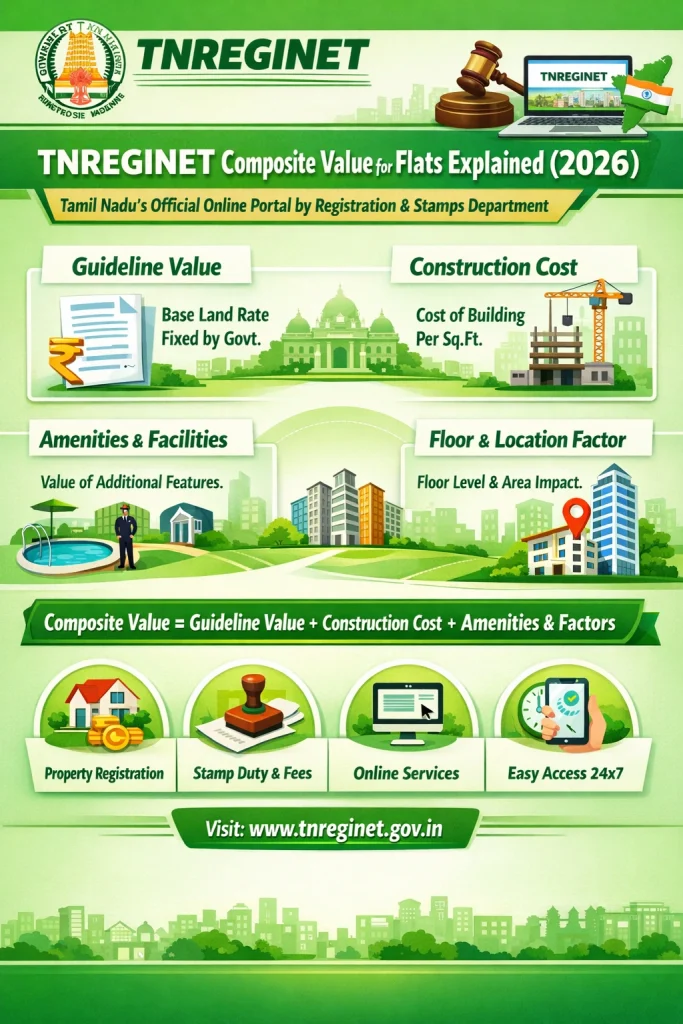
For flats, composite value means the combined value of:
Tamil Nadu later defined “composite value” in its rules as the market value of apartments/flats/villas/villament/row houses including undivided share of land and calculated on the basis of super built-up area.

Quick answer
In TNREGINET-related flat registration, composite value is the all-in-one value of a flat that includes both the buyer’s share in the land and the constructed unit, usually linked to the super built-up area. It was introduced for the first sale of apartments/flats/villas/row houses/villaments in real estate projects, and the official notification says the market value for such first-sale documents will be the value shown in the document or the composite value, whichever is higher.
You can also read: Guideline Value vs Market Value in Tamil Nadu Update (2026)
What does “composite value” really mean?
Think of it like this.
Earlier, flat deals were often split into:
That made the process harder for normal buyers to understand. Tamil Nadu’s 2024–25 policy note says the state implemented composite value for first sale of multi-storey apartments from 01.12.2023, and explains that these projects are sold on an aggregate value basis, meaning the value of undivided land area plus building, usually on a per-square-foot basis.
So in plain words:
Composite value = land share + flat construction value, combined into one value
Why was this system introduced?
The change was brought in to simplify how first-sale flats are registered. Housing’s report on the reform says that from December 1, 2023, Tamil Nadu started a revised system for registering sale deeds of properties in multi-storey apartments, where the sale deed can be registered on the basis of the land and building’s composite value, and a separate construction agreement is not needed for that first-sale setup.
That is the main reason this term matters. It is not just another property buzzword. It changes how first-sale flat registration is understood.
Does composite value apply to every flat sale?
No. This is one of the most important points.
The official 2023 government notification and Housing’s explainer both point in the same direction: this system is for the first sale of apartment/flat/villa/row house/villament in a real estate project. Housing says clearly that it is applicable only for first sale of apartments and not for resale properties.
So if you are buying a resale flat, you should not assume the same “composite value” treatment automatically works in the same way.
How is composite value different from guideline value?
This is where many articles confuse readers.
Guideline value is the government benchmark for land/property in an area.
Composite value is the all-in-one value for a first-sale flat that includes UDS + building, linked to super built-up area.
Market value is the real value used in the transaction context.
The official rule definition ties composite value directly to the market value of the flat/unit including UDS, not just raw land rate.
So if someone tells you, “Just check the street guideline value and you’ll know the flat value,” that is incomplete. For flats, composite value is broader than only land guideline value.
How is composite value different from UDS value?
UDS means your undivided share in the land. It is only the land part.
Composite value is bigger because it includes:
That is why the policy note calls it an aggregate value, and why the gazette says the value is calculated for the apartment/flat itself including the UDS.
Why does super built-up area matter here?
The official rule language says composite value is calculated on the basis of super built-up area. That means the flat valuation here is not limited to only carpet area or only land share. It is tied to the broader saleable area concept used in many apartment projects.
In simple words, the rate is meant to reflect the full flat package, not just one narrow part of it.
Easy example
Let’s say a builder sells a flat in a new apartment project.
Earlier, the paperwork may have looked like this:
Under the composite-value approach for eligible first-sale cases, the government treats the flat more as one combined property value. The policy note describes this as the aggregate value of undivided land area plus building.
So if your flat is advertised and sold as one combined package, that is exactly the kind of situation where “composite value” makes sense.
Does composite value affect stamp duty and registration?
Yes, it matters because the reform was tied to duty changes for these first-sale documents. The December 1, 2023 notification was specifically about reduction in stamp duty and fixation of composite value for first-sale deeds of apartment/flat/villa/row house/villament. Housing’s summary says the revised system introduced lower stamp-duty slabs for certain first-sale composite-value transactions and also explains the older split system of UDS deed plus construction agreement charges.
What is the most important legal point buyers should know?
This line matters a lot:
The 2023 gazette says that, for these eligible first-sale real estate project documents, the market value shall be the value set forth in the document or the composite value calculated in terms of super built-up area, whichever is higher.
That means you should not assume you can ignore the notified composite value if the document shows a lower figure.
Is composite value shown as a normal public guideline search on TNREGINET?
Be careful here.
The official TNREGINET portal clearly offers public services like Search/View EC and public guideline search tools, but the sources I checked do not clearly show a simple public-facing “composite value for flats” search box in the same way. The stronger official basis for this topic comes from the government notification, rule definition, and the department policy note, rather than from a clearly surfaced public search screen on the homepage.
So in your article, it is better to explain the concept correctly than to promise a specific public button unless you have verified that interface yourself.
Why buyers get confused
People usually get confused because they compare three different things:
These are not the same. Composite value is meant to combine the parts into one flat-level valuation for eligible first-sale cases. That is exactly what the official policy note and rule definition clarify.
Simple takeaway
If you are buying a new flat from a builder in Tamil Nadu, “composite value” usually means the government-recognized combined value of the land share and the built flat, based on super built-up area. If you are buying a resale flat, do not assume the same rule applies in the same way, because the reform was framed for first sale.
FAQs
Final Words
The easiest way to understand TNREGINET composite value for flats is this:
It is the flat’s combined value, not just the land value.
It includes the UDS and the building part, and for eligible first-sale apartment projects in Tamil Nadu, it is linked to super built-up area. That is why it matters during registration, and that is why it should not be confused with simple street guideline value or UDS alone.